Buying Bitcoin in 2026: Everything You Need to Know
Bitcoin is the most widely held cryptocurrency in the world, and buying it has never been easier. Whether you want to invest $50 or $50,000, the process follows the same five steps. This guide walks you through each one in detail, compares payment methods across major exchanges, and shares practical tips for first-time buyers to avoid common mistakes.
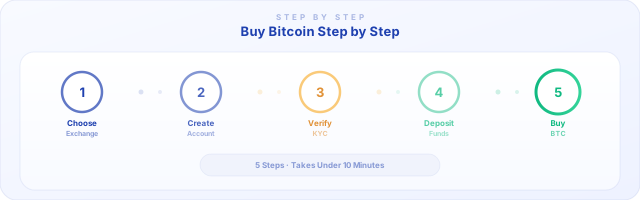
Step 1: Choose a Crypto Exchange
Your choice of exchange affects everything — the fees you pay, the payment methods available, the security of your funds, and the overall experience. For US-based buyers, regulated exchanges are the safest choice. Binanceis the world's largest exchange by trading volume, offering deep liquidity and a wide range of features. Kraken is a veteran US-friendly exchange known for strong security and regulatory compliance. Crypto.comoffers a user-friendly mobile app that's ideal for beginners.
For traders who also want derivatives, copy trading, or lower fees, Bitget and Bybit Global are strong options with competitive fee structures and advanced trading tools. If you primarily want automated trading, Pionex includes built-in trading bots at no extra cost.
Step 2: Create and Verify Your Account
Registration on most exchanges takes under 5 minutes. You'll need to provide an email address or phone number and create a strong, unique password. Most regulated exchanges require identity verification (KYC) before you can deposit fiat currency or make larger trades. KYC typically involves uploading a government-issued ID (passport or driver's license) and sometimes a selfie for facial verification.
Verification times vary significantly. Binance and Crypto.com often verify accounts within minutes using automated systems. Kraken can take a few hours during peak periods. If you want to start trading immediately without KYC, some exchanges like MEXC allow crypto-to-crypto trading without identity verification, though fiat deposits typically still require it.
Immediately after creating your account, enable two-factor authentication (2FA) using an authenticator app like Google Authenticator or Authy. This is the single most important security step you can take.
Step 3: Deposit Funds
Once your account is set up, you need to deposit funds. The available payment methods and their fees vary by exchange:
Bank wire transfer (ACH/SEPA): The cheapest option on most exchanges, often free or with minimal fees. Processing takes 1-3 business days for ACH transfers in the US, and typically 1 day for SEPA in Europe. Kraken, Binance, and Crypto.com all support bank transfers with low or zero fees.
Credit/debit card: Instant deposits but with higher fees, typically 1.5-3.5% of the transaction amount. Most major exchanges accept Visa and Mastercard. Binance charges around 1.8% for card deposits, while Crypto.com offers free card deposits for the first 30 days. Note that some credit card issuers treat crypto purchases as cash advances, adding additional fees.
Apple Pay and Google Pay: Available on select exchanges including Crypto.com and Binance (in some regions). Offers the convenience of mobile payments with fees similar to card deposits.
P2P (Peer-to-Peer): Platforms like Binance P2P and Bybit Global P2P connect you directly with other users. You can often find competitive rates and flexible payment methods including bank transfer, PayPal, Zelle, and more. The exchange acts as escrow to protect both parties.
Step 4: Place Your Buy Order
With funds in your account, navigate to the BTC/USD (or BTC/USDT) trading pair. You have two main order types:
Market order: Buys Bitcoin instantly at the current market price. Best for beginners who want a simple, immediate purchase. The downside is that you may pay a slightly higher price due to the bid-ask spread, especially during volatile periods.
Limit order:Sets the maximum price you're willing to pay. Your order only executes when the market reaches your price or better. This gives you more control and often results in lower fees (maker fees vs. taker fees). The trade-off is that your order may not fill if the price doesn't reach your limit.
For first-time buyers purchasing a smaller amount, a market order is perfectly fine. The difference in execution price is negligible on high-liquidity exchanges. On Binance and Kraken, BTC trading pairs have deep order books that minimize slippage even for market orders.
You do not need to buy a whole Bitcoin. Every exchange allows you to purchase fractional amounts — you can start with as little as $1-10 depending on the platform.
Step 5: Secure Your Bitcoin
Once you've purchased Bitcoin, you need to decide where to store it. Leaving it on the exchange is convenient for active trading but carries counterparty risk — if the exchange is hacked or goes bankrupt, you could lose your funds (as FTX customers learned in 2022).
For long-term holdings, transfer your Bitcoin to a self-custody wallet. Hardware wallets like Ledger and Trezor store your private keys offline, making them virtually immune to online attacks. Software wallets like BlueWallet or Sparrow offer a free alternative with good security for moderate amounts. Our wallet guide covers all wallet types in detail.
Write down your seed phrase (12 or 24 words) on paper and store it in a secure location. Never store it digitally — not in a notes app, not in cloud storage, not in a screenshot. If someone gets your seed phrase, they get your Bitcoin.
Tips for First-Time Bitcoin Buyers
Start small. There is no minimum amount you need to invest, and your first purchase should be an amount you're comfortable losing entirely as you learn. Use dollar-cost averaging (DCA) — buying a fixed amount at regular intervals (weekly or monthly) — rather than trying to time the market. DCA reduces the impact of volatility and removes the emotional stress of picking the "right" moment.
Compare fees before committing to an exchange — our Fee Calculator can help you estimate costs. The difference between 0.1% and 1.5% in fees adds up significantly over time. Bank transfers are almost always cheaper than card payments. If you plan to be an active trader, fee rebates through referral links at exchanges like Bitget and MEXC can save you meaningful amounts.