Why Crypto Regulation Matters
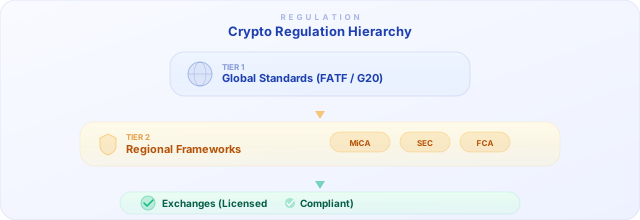
Regulation determines which exchanges you can use, how your funds are protected, and what legal obligations you have as a trader. Using a regulated exchange means your assets are held under established legal frameworks, the platform must meet capital requirements, and you have legal recourse if something goes wrong. Unregulated exchanges may offer more features or fewer restrictions, but they also carry higher counterparty risk.
For everyday traders, understanding the regulatory landscape helps you make informed decisions about where to keep your money. Regulatory compliance is not just about following rules — it is a signal of operational maturity, financial stability, and commitment to user protection. As the industry matures, regulation is becoming a competitive advantage rather than a burden.
United States: SEC, CFTC, and State Laws
The United States has one of the most complex regulatory environments for crypto. The Securities and Exchange Commission (SEC) oversees tokens it classifies as securities, while the Commodity Futures Trading Commission (CFTC) regulates crypto derivatives and considers Bitcoin a commodity. This dual oversight has created jurisdictional battles and significant uncertainty for exchanges operating in the US.
At the state level, regulations vary widely. New York requires exchanges to obtain a BitLicense, one of the most stringent crypto licenses in the world. Other states have lighter requirements or defer to federal guidance. The result is a patchwork system where exchanges must navigate dozens of different state-level rules while also complying with federal regulations, anti-money laundering (AML) laws, and tax reporting requirements.
Major exchanges operating in the US include Kraken, Crypto.com, and Coinbase. These platforms comply with US regulations but typically offer fewer trading pairs and features compared to their international counterparts. US residents are generally restricted from accessing offshore exchanges, although enforcement varies.
European Union: MiCA Regulation
The Markets in Crypto-Assets (MiCA) regulation is the EU's comprehensive framework for crypto oversight, fully applicable since December 2024. MiCA establishes clear rules for crypto asset service providers (CASPs) including licensing requirements, capital reserves, custody standards, consumer protection measures, and transparency obligations.
For traders in the EU, MiCA means that licensed exchanges must protect your funds, maintain adequate reserves, and operate transparently. Exchanges like Binance, Kraken, and Crypto.com have obtained or are in the process of obtaining MiCA licenses. BingX, by contrast, holds no EU license and operates via non-EU registrations.
MiCA is considered the gold standard of crypto regulation globally. It provides legal certainty for both companies and users, and it is already influencing regulatory approaches in other jurisdictions. For EU residents, choosing a MiCA-licensed exchange offers the highest level of regulatory protection currently available anywhere.
United Kingdom: FCA Regulation
The UK Financial Conduct Authority (FCA) requires all crypto firms operating in the UK to register for anti-money laundering compliance. The FCA has been notably strict, rejecting a significant percentage of applications and maintaining a relatively short list of approved firms. The UK also restricts the sale of crypto derivatives and ETNs to retail consumers.
The UK is developing a broader regulatory framework that may include requirements similar to MiCA. Until that framework is finalized, the FCA registration provides a baseline level of oversight focused primarily on AML and counter-terrorism financing rather than comprehensive consumer protection or market integrity standards.
Other Major Regulatory Frameworks
Japan was among the first countries to regulate crypto exchanges through its Financial Services Agency (FSA). Japanese exchanges must segregate customer funds and meet strict cybersecurity standards. Singapore regulates crypto through the Monetary Authority of Singapore (MAS) under its Payment Services Act, requiring licensing for digital payment token services.
Hong Kong has introduced a mandatory licensing regime for virtual asset trading platforms through the Securities and Futures Commission (SFC). Dubai and Abu Dhabi have created dedicated crypto regulatory frameworks (VARA and ADGM) designed to attract global crypto companies. Australia regulates crypto through AUSTRAC for AML purposes, with broader licensing reforms under development.
What "Regulated" Means for an Exchange
When an exchange says it is "regulated," it means the platform holds a license from a recognized financial authority and must comply with specific rules. These typically include: segregation of customer funds from company funds, Know Your Customer (KYC) and Anti-Money Laundering (AML) procedures, minimum capital requirements, regular audits, cybersecurity standards, and complaint resolution mechanisms.
Not all regulations are created equal. A license from a well-established authority like the EU (MiCA), Japan (FSA), or Singapore (MAS) carries more weight than registration in a jurisdiction with minimal oversight. When evaluating an exchange, check which specific license it holds and from which authority. Exchanges like Bybit Global and Bitget hold multiple licenses across different jurisdictions, providing broader regulatory coverage.
Impact on Traders
Regulation affects your daily trading experience in several ways. Regulated exchanges require KYC verification, which means providing identification documents before you can trade. This adds friction but also protects against fraud and enables account recovery if you lose access. Regulated exchanges may also restrict certain products — for example, EU regulations limit leverage for retail traders.
On the positive side, regulated exchanges are far less likely to suffer the kind of catastrophic failure seen with FTX in 2022. Regulatory oversight means regular audits, proof of reserves requirements, and legal accountability for exchange operators. For traders who prioritize security over maximum feature availability, regulated exchanges are the clear choice.
How to Check If an Exchange Is Licensed
Always verify an exchange's regulatory claims independently. For EU MiCA licenses, check the European Securities and Markets Authority (ESMA) registry. For UK FCA registration, search the FCA's Financial Services Register. For US operations, check FinCEN's MSB registration list and state-level regulators. Most reputable exchanges list their license numbers and regulatory status on their websites, typically in the footer or on a dedicated compliance page.
Be cautious of exchanges that make vague claims like "fully compliant" without specifying which license they hold from which authority. Legitimate regulation is specific, verifiable, and public. At CryptoExchangePicks, we track the regulatory status of every exchange we review and clearly indicate whether a platform is fully regulated, pending approval, or unregulated in our comparison tables.