Quick Answer: How Do MEXC Fees Compare?
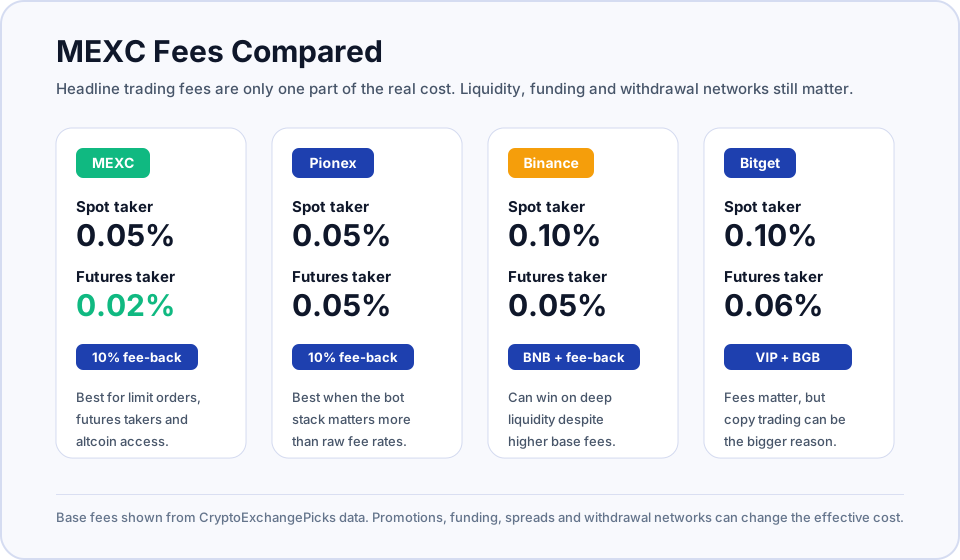
MEXC is one of the cheapest exchanges in our comparison, but it is not automatically the cheapest for every trade. The current CryptoExchangePicks data set uses 0% spot maker fees, 0.05% spot taker fees, 0% futures maker fees and 0.02% futures taker fees as the baseline for MEXC. MEXC's official materials also show that futures rates can differ by region, pair, promotion, account setting and order channel, so always check the live fee page and order ticket before trading.
MEXC Fee Checklist
| Fee area | MEXC baseline | Why it matters | Check before trading |
|---|---|---|---|
| Spot maker / taker | 0% / 0.05% | Strongest for limit orders and still cheap for market orders. | Pair-specific fee, spread and whether your order adds liquidity. |
| Futures maker / taker | 0% / 0.02% in the current site data and MEXC Futures FAQ. | A major edge for active derivatives traders using frequent entries and exits. | Live fee page, region, contract, funding rate and liquidation risk. |
| Withdrawal fees | Asset and network dependent. | A cheap trade can become expensive if the transfer network is wrong. | Coin, network, minimum withdrawal and destination support. |
| API trading fees | Separate schedule; standard web and app rates may not apply. | Automated strategies can pay materially different rates. | Current API announcement, eligible pair and account fee page. |
| Fee-back and MX | 10% CryptoExchangePicks fee-back plus possible MX-related discounts. | Most valuable on taker fees, not on already-zero maker fees. | Eligibility, referral status, MX settings and non-stackable discounts. |
| Hidden costs | Spread, slippage, funding and network routing. | These can exceed the visible platform fee on thin pairs or leveraged trades. | Order book depth, funding history and transfer route. |
MEXC vs Pionex vs Binance vs Bitget
| Exchange | Spot maker / taker | Futures maker / taker | Main fee angle | Cost trap |
|---|---|---|---|---|
| MEXC | 0% / 0.05% | 0% / 0.02% | Lowest futures taker fee in this group plus 10% fee-back. | Thin altcoin books can make spread bigger than the fee. |
| Pionex | 0.05% / 0.05% | 0.02% / 0.05% | Same spot taker fee as MEXC and strong built-in bot tooling. | Bots can increase turnover and total fees if overused. |
| Binance | 0.10% / 0.10% | 0.02% / 0.05% | Higher base fees, but deep liquidity and BNB discounts can help. | Headline fee is not the only cost; token discounts need setup. |
| Bitget | 0.10% / 0.10% | 0.02% / 0.06% | Useful if copy trading or BGB/VIP perks are part of your setup. | Copy trading results can matter more than the fee rate. |
Why MEXC Fees Need a Real Comparison
MEXC fees look simple at first: low maker fees, very low futures taker fees, fee-back through CryptoExchangePicks and occasional zero-fee spot campaigns. The problem is that exchange fees only tell part of the story. A trader using limit orders on a liquid pair can pay almost nothing in explicit trading fees. A trader market-buying a small altcoin can still lose more to spread and slippage than the exchange fee itself.
This article compares MEXC with Pionex, Binance and Bitget because those exchanges represent three common alternatives: bot trading, global liquidity and copy trading. The goal is not to crown the exchange with the lowest number in one column. The goal is to show when MEXC is genuinely cheaper, when another exchange can still make sense, and which hidden costs you should check before trading.
If you want the wider market overview, start with the crypto fees comparison. If you already know your monthly volume, use the fee calculator after reading this article.
Spot Fees: MEXC vs Pionex, Binance and Bitget
Spot trading is where most users first compare exchange costs. MEXC is strongest when you place limit orders that add liquidity to the book. In our current data, the MEXC spot maker fee is 0%. That means a resting limit order can trade without a platform trading fee. Pionex also has low spot fees at 0.05% maker and 0.05% taker. Binance and Bitget both sit at 0.10% maker and 0.10% taker before discounts in our comparison data.
For market orders, MEXC and Pionex are tied in this focused comparison at 0.05% spot taker. Binance and Bitget are twice as high on the base spot taker line at 0.10%. That difference is easy to see on smaller trades and becomes more visible as volume rises. At $10,000 in spot taker volume, a 0.05% fee costs $5. A 0.10% fee costs $10. At $100,000, the gap is $50 versus $100 before discounts or fee-back.
The caveat is liquidity. Binance can sometimes be cheaper in practice on very liquid BTC or ETH orders even if the base fee is higher, because the spread may be tighter and execution quality may be stronger. MEXC can be cheaper on the explicit fee line, especially for altcoins and limit orders, but users should inspect the order book before placing size. A 0.05% fee advantage disappears quickly if the spread is 0.30% on a thin pair.
Spot Taker Cost by Volume
| Monthly spot taker volume | MEXC 0.05% | Pionex 0.05% | Binance 0.10% | Bitget 0.10% |
|---|---|---|---|---|
| $1,000 | $0.50 | $0.50 | $1.00 | $1.00 |
| $10,000 | $5.00 | $5.00 | $10.00 | $10.00 |
| $100,000 | $50.00 | $50.00 | $100.00 | $100.00 |
The table shows base fees only. It does not include fee-back, token discounts, VIP tiers, spreads, slippage or promotions. Through CryptoExchangePicks, MEXC and Pionex both have a 10% fee-back angle in the current data. Binance can also be reduced through fee-back and BNB discounts. Bitget can become more competitive through VIP perks and BGB-related discounts.
Futures Fees: Where MEXC Has the Clearest Edge
Futures fees are where MEXC separates itself most clearly from Pionex, Binance and Bitget in this article, but this is also the section where source precision matters most. The current CryptoExchangePicks data set and MEXC's Futures FAQ show MEXC at 0% maker and 0.02% taker. MEXC's separate MX fee-deduction article lists a different standard futures schedule of 0.01% maker and 0.04% taker before MX discount, while also saying rates can vary by country, region and pair. Treat the 0% / 0.02% line as the current article baseline, then verify the live fee page and contract screen before placing a trade.
On $100,000 in futures taker volume, MEXC's 0.02% base taker fee equals $20. Pionex and Binance at 0.05% equal $50. Bitget at 0.06% equals $60. That is before fee-back and before any VIP or token discounts. For scalpers or high-turnover derivatives traders, MEXC's futures taker fee can be the most important number in the comparison.
But futures are not cheap just because the trading fee is cheap. Perpetual contracts also have funding rates, liquidation risk, spread, market impact and execution risk. A trader who saves $30 in taker fees can lose much more by using excessive leverage or holding a crowded position through several funding intervals. Before trading futures, read our leverage trading risk guide.
API traders need a separate calculation. MEXC states that API futures trading follows its own fee schedule, which can override web and app rates, promotional offers and MX discounts. If you use a trading bot or connect through the API, do not apply the headline 0% / 0.02% baseline automatically. Check the latest API fee announcement and the rate shown for your account before estimating strategy costs.
Futures Taker Cost by Volume
| Monthly futures taker volume | MEXC 0.02% | Pionex 0.05% | Binance 0.05% | Bitget 0.06% |
|---|---|---|---|---|
| $1,000 | $0.20 | $0.50 | $0.50 | $0.60 |
| $10,000 | $2.00 | $5.00 | $5.00 | $6.00 |
| $100,000 | $20.00 | $50.00 | $50.00 | $60.00 |
Withdrawal Fees: Compare Networks, Not Just Exchanges
Withdrawal fees are harder to compare than trading fees because the cost changes by asset and network. A USDT withdrawal on one network can be much cheaper than the same asset on another network. ETH on Ethereum mainnet can be more expensive during congestion than a stablecoin transfer on a cheaper chain. That is true for MEXC, Pionex, Binance and Bitget.
For that reason, this article does not present a single universal "MEXC withdrawal fee" number. It would be misleading. The useful comparison is operational: which exchange supports the asset you want, which network is available on both sides, what the live withdrawal page shows, and whether the receiving wallet supports that exact network. The cheapest withdrawal option is useless if the destination does not support it.
The practical rule is simple: compare withdrawal fees at the moment you withdraw. Check the coin, network, minimum amount and destination support. For large withdrawals, send a small test transaction first. The extra network cost is usually cheaper than losing access to the full amount. For the full workflow, use our guide on how to transfer crypto between exchanges.
Fee-Back, Token Discounts and VIP Tiers
Public fee tables show the base rate, but fee-back and token discounts change the effective rate. MEXC has a 10% fee-back angle through CryptoExchangePicks and can also be affected by MX token benefits or VIP status. MEXC's MX guide describes fee deductions for both spot and USDT-M futures, but says benefits can depend on account eligibility and that some pairs are excluded. Pionex also has fee-back in the current data, including relevance for grid bot users. Binance combines fee-back with BNB-based discounts. Bitget can become cheaper through VIP perks and BGB-related discounts.
The biggest impact is on fees you actually pay. A 10% rebate on a $0 maker fee is still $0. It matters more for taker orders and high-volume futures trading. If you pay $50 in eligible taker fees, a 10% fee-back is worth $5. If you pay $500, it is worth $50. That is why small occasional users should focus first on order type and network selection, while active users should also compare fee-back, VIP levels and token settings.
Token discounts are useful only if the token exposure makes sense. Holding MX, BNB or BGB can reduce fees or unlock perks, but the token price can move against you. A token discount that saves $20 is not helpful if the token position loses $100. Treat token-based discounts as part of a broader trading setup, not as a reason to hold exchange tokens blindly. Current promotional offers are listed in the bonus comparison.
When MEXC Is Cheaper
MEXC is usually the strongest choice in this comparison when you use limit orders, trade futures actively, want broad altcoin access or care about explicit trading fees more than product extras. A 0% spot maker fee is hard to beat for patient limit-order traders. A 0.02% futures taker fee is very competitive for active derivatives traders. The 10% fee-back makes the effective cost better for eligible taker-heavy users.
MEXC also becomes attractive when you are trading smaller altcoins that are not available everywhere. In that case, the comparison is not only MEXC versus Binance or Bitget on fee percentage. It is whether the exchange lists the pair at all, whether the order book is usable, and whether you can exit without excessive slippage. Low fees help, but liquidity still decides the real execution cost.
When Another Exchange Can Be Cheaper
Pionex can be the better choice if your strategy depends on built-in bots. MEXC may have the lower futures taker fee, but a bot platform can reduce operational mistakes if you actually use the automation. However, bots can increase trading frequency, so the total fees may rise even when the rate per trade looks low.
Binance can be cheaper in practice for large, liquid market orders if its spread and depth are better enough to offset the higher base fee. That is especially relevant for BTC, ETH and other major pairs. Bitget can be worth the higher base futures taker fee if copy trading is the reason you are using the exchange. In that case, the cost of a poor copied strategy matters more than a 0.04 percentage point fee difference.
Regulation can also change the decision. MEXC is not listed here as a confirmed MiCA-regulated exchange for the global platform. Binance and Bitget are shown as pending in the current data. If regulatory protection is your priority, you may prefer a regulated alternative even when the explicit trading fee is higher. For that angle, read the MiCA deadline guide and compare all exchanges in the comparison table.
Hidden Costs That Can Beat the Fee Table
The first hidden cost is spread. If the best bid and ask are far apart, the spread can cost more than the platform fee. This matters especially on smaller altcoins, where MEXC may list assets earlier than larger exchanges. Early access is valuable, but thin liquidity can make market orders expensive.
The second hidden cost is slippage. A visible fee of 0.05% does not mean your total cost is 0.05%. If your order pushes through several levels of the book, the average execution price may be worse than expected. Splitting a large order or using limit orders can reduce that risk.
The third hidden cost is funding. Futures traders often focus on the 0.02% MEXC taker fee and ignore recurring funding payments. If you hold a position for days, funding can exceed entry and exit fees. This can happen on any perpetual futures platform, including Pionex, Binance and Bitget.
The fourth hidden cost is withdrawal routing. Using an expensive network for a small transfer can erase the benefit of low trading fees. Before moving funds, compare the live withdrawal screen, the supported destination networks and the minimum withdrawal amount.
Practical Recommendation
Choose MEXC if your main goal is low explicit trading fees, especially for spot maker orders, futures taker orders and altcoin access. Use limit orders where possible, check the live fee shown in the order screen, and compare the spread before placing size. If you trade futures, factor in funding and liquidation risk before treating the low taker fee as the whole cost.
Choose Pionex if bot tooling is the reason you are trading. Choose Binance if you need deep liquidity and broad market infrastructure. Choose Bitget if copy trading or its VIP ecosystem is central to your strategy. The cheapest exchange is not always the one with the lowest fee table. It is the one with the lowest total cost for the way you actually trade.
For many users, the best setup is not one exchange only. You might use MEXC for low-fee altcoin trades, Pionex for grid bots, Binance for deep liquidity and Bitget for copy trading experiments. Keep long-term holdings in a custody setup that matches your risk tolerance, and avoid choosing an exchange only because one fee column looks attractive.
Sources and Fee Verification
This guide uses the CryptoExchangePicks exchange data set plus official MEXC fee materials. Because MEXC says maker and taker rates may vary with platform events, user region, account eligibility and trading pair, the final source of truth is always the live fee page and the fee shown in your order or withdrawal screen.
- MEXC Fee Overview for live spot, futures, deposit and withdrawal fee checks.
- MEXC Futures Trading FAQ for the 0% maker / 0.02% taker futures reference and funding-risk explanation.
- MEXC MX fee discount guide for MX deduction rules, eligibility caveats and the alternative standard futures fee schedule.
- MEXC API futures fee update for the separate fee schedule that applies to API orders.
For a broader platform view, compare the MEXC review, the fee calculator, the crypto fees comparison, the bonus comparison and the full exchange comparison table.
Bottom Line
MEXC is the fee leader in this focused comparison for futures taker orders and spot maker orders. It also ties Pionex on spot taker fees and beats Binance and Bitget on the base spot taker line. That makes MEXC a strong choice for fee-sensitive traders who understand order types and execution quality.
The final decision still depends on your trading style. Pionex can win for bots, Binance can win on liquidity, and Bitget can win for copy trading. Before deciding, compare the fee table, spread, funding, withdrawal network, fee-back eligibility and regulatory status together. That is the only fair way to judge whether MEXC is truly cheaper for you.