What Are Altcoins?
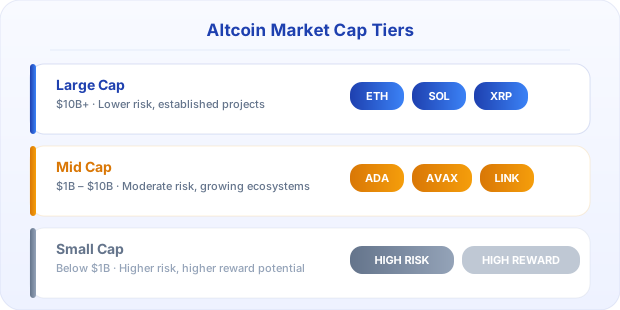
Every cryptocurrency that is not Bitcoin is considered an altcoin — short for "alternative coin." The term covers everything from Ethereum, the second-largest cryptocurrency by market cap, all the way down to micro-cap tokens launched yesterday. As of 2026, there are over 15,000 altcoins trading across hundreds of exchanges, representing a combined market capitalization of more than $1.5 trillion.
While Bitcoin serves primarily as a store of value and digital gold, altcoins power a vast ecosystem of decentralized applications, smart contracts, cross-border payments, oracle networks, and more. Buying altcoins gives you exposure to specific sectors of the crypto economy — from DeFi and gaming to real-world asset tokenization and AI-driven protocols.
Top Altcoins to Know in 2026
Ethereum (ETH)
Ethereum is the backbone of decentralized finance and the leading smart contract platform. Its market cap consistently places it as the second-largest cryptocurrency, and it is the only altcoin with approved spot ETFs in the United States.
Solana (SOL)
Solana has cemented its position as the high-performance alternative to Ethereum. With transaction speeds exceeding 4,000 TPS and fees measured in fractions of a cent, Solana attracts developers building consumer-facing applications and decentralized exchanges.
XRP
XRP focuses on cross-border payments and institutional settlement. Following the resolution of its extended legal battle with the SEC, XRP has seen renewed institutional adoption.
Cardano (ADA)
Cardano takes a research-driven approach to blockchain development. Built on peer-reviewed academic papers, Cardano has steadily rolled out smart contract capabilities and governance features.
Avalanche (AVAX)
Avalanche combines high throughput with a unique subnet architecture that lets enterprises create custom blockchains. It has become a popular choice for real-world asset tokenization.
Chainlink (LINK)
Chainlink provides the oracle infrastructure that connects blockchains to real-world data. Nearly every major DeFi protocol relies on Chainlink price feeds.
Best Exchanges for Buying Altcoins
MEXC — Largest Altcoin Selection
MEXC stands out with over 2,000 listed cryptocurrencies, making it the go-to exchange for finding newly launched tokens and niche altcoins. Zero spot trading fees on many pairs make it particularly attractive.
Binance — Depth and Liquidity
Binance offers around 400 altcoins with deep liquidity on most pairs. Binance Launchpad also gives users early access to new token launches.
Gate Global — Early Listings
Gate Global rivals MEXC in listing speed, frequently adding new tokens within hours of launch. Note that Gate Global is separate from Gate Europe, the MiCA-regulated EU spot offer.
KuCoin — Hidden Gems
KuCoin Globalhas built a reputation as the "people's exchange" for altcoin discovery. With 800+ tokens listed, it strikes a balance between selection and quality.
Bitget — Copy Trading and Altcoins
Bitgetcombines a solid altcoin selection of 800+ tokens with its popular copy trading feature. If you are new to altcoin trading, you can follow experienced traders' positions while learning the market.
How to Buy Your First Altcoin: Step by Step
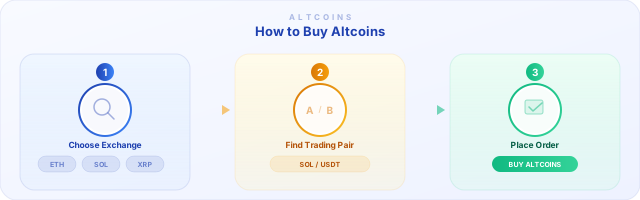
Step 1: Choose an Exchange and Create an Account
Pick an exchange based on which altcoins you want to buy. For smaller or newly launched tokens, start with MEXC or Gate Global for the broadest selection.
Step 2: Deposit Funds
Most exchanges accept deposits via bank transfer, credit card, or cryptocurrency. Bank transfers usually have the lowest fees. If you already own Bitcoin or USDT, you can deposit that directly.
Step 3: Navigate to the Trading Pair
Search for the altcoin using its ticker symbol — for example, SOL, XRP, or ADA. Select the trading pair that matches your deposited currency. The most common pairs are against USDT.
Step 4: Place Your Order
Use a limit order rather than a market order. A limit order lets you set the exact price you are willing to pay, protecting you from slippage during volatile moments.
Step 5: Secure Your Holdings
For smaller amounts or active trading, leaving them on a reputable exchange is acceptable. For larger holdings, transfer to a hardware wallet like a Ledger or Trezor.
Research Checklist Before Buying Any Altcoin
Tokenomics
Examine the total supply, circulating supply, and token unlock schedule. A token where 80% of supply is still locked and controlled by insiders is a very different investment than one with 90% already in circulation.
Team and Development Activity
Check GitHub for development activity — a project with regular code commits is a healthier sign than one where the last update was six months ago.
Use Case and Market Fit
Ask: what problem does this token solve, and does it need a blockchain to solve it? The strongest altcoins have clear utility.
Liquidity and Volume
Avoid tokens with less than $500,000 in daily volume unless you understand and accept the liquidity risk.
Risk Management for Altcoin Portfolios
Position Sizing
Never put more than 5-10% of your total crypto portfolio into a single altcoin. Many experienced traders use a tiered approach: 50-60% in Bitcoin and Ethereum, 20-30% in large-cap altcoins, and 10-20% in higher-risk plays.
Take Profits Systematically
A common approach is to sell 25% at a 2x gain, another 25% at a 4x gain, and let the remainder run with a trailing stop.
Watch Correlation to Bitcoin
Most altcoins are highly correlated with Bitcoin. When BTC drops sharply, altcoins typically fall harder. Understanding this dynamic helps you time entries and manage exposure.