
How Grid Trading Works
Grid trading is a systematic strategy that profits from the natural price volatility of crypto markets. Instead of trying to predict whether a coin will go up or down, you define a price range and let the bot trade the oscillations within it. The bot places a ladder of buy orders below the current price and sell orders above it. Each completed buy-sell cycle earns a small profit equal to the gap between grid lines.
This approach works because crypto prices rarely move in a straight line. Even during strong trends, there are pullbacks and bounces. A grid bot captures these micro-movements automatically, accumulating profits around the clock. Over time, hundreds of small trades can compound into meaningful returns, especially in markets where the price swings 2-5% daily.
Setting Up a Grid Bot: Step by Step
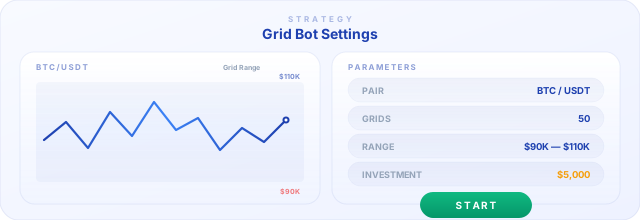
Every grid bot requires four core parameters. First, the trading pair — for example, BTC/USDT or ETH/USDT. Second, the lower price boundary, which is the lowest price at which you want the bot to buy. Third, the upper price boundary, the highest price at which you want the bot to sell. Fourth, the grid count, which determines how many buy and sell levels the bot creates between the boundaries.
On platforms like Pionex and Bitget, you can also let AI suggest these parameters based on recent price data. The AI analyzes historical volatility, support and resistance levels, and trading volume to recommend an optimized range. This is a solid starting point, especially for beginners, though manual adjustment based on your own market analysis often improves results.
Choosing the Right Coin Pair
Not all trading pairs are equally suited for grid bots. The ideal pair has high liquidity (tight spreads, large order books), consistent volatility (regular price swings of 1-5%), and a history of range-bound trading. Major pairs like BTC/USDT and ETH/USDT are the safest choices because of their deep liquidity and predictable volatility patterns.
Mid-cap altcoin pairs can offer higher returns due to greater volatility, but they carry additional risks: thinner order books, wider spreads, and the potential for sudden price crashes. Avoid running grid bots on newly listed tokens, meme coins with extreme volatility, or pairs with low daily trading volume. Stable pairs like BTC/USDT or ETH/USDT during consolidation phases are where grid bots shine.
Strategies for Different Market Conditions
In a sideways market, standard spot grid bots perform at their best. The price bounces between support and resistance, hitting grid lines repeatedly. Set your range slightly beyond recent highs and lows to account for minor breakouts. A grid count of 30-50 with moderate spacing typically works well.
In a bull market, use an infinity grid or set a wider-than-usual upper boundary. You want the bot to keep selling as the price climbs rather than stopping at a fixed ceiling. Alternatively, run a spot grid on a shorter timeframe and manually adjust the range upward as the trend progresses.
In a bear market, consider a reverse grid bot that sells your holdings into the decline and buys back cheaper. Another option is a futures grid bot in short mode. If you prefer staying in spot, tighten your range to the current support zone and reduce your grid investment to limit downside exposure. Never fight the trend with large capital in a grid bot.
Risk Management for Grid Bots
The primary risk is a price breakout beyond your grid range. If the price crashes below your lower boundary, you hold the full bag at an unrealized loss. If it surges above your upper boundary, you miss the rally. Set stop-loss orders below your lower grid line to limit losses, and consider taking partial profits when the bot performs well.
Never allocate your entire portfolio to a single grid bot. Diversify across multiple pairs and strategies. A reasonable starting allocation is 10-20% of your trading capital per bot. Monitor your bots weekly rather than obsessing over daily performance. And always account for trading fees — on platforms like Pionex, bot usage is free with standard trading fees, while other exchanges may have additional charges.
Expected Returns
Realistic returns for a well-configured spot grid bot in a ranging market are 0.5-2% per week, or roughly 2-8% per month. These numbers depend heavily on market volatility, grid spacing, and the specific trading pair. Backtesting data on platforms like KuCoin Global can give you a historical estimate before you commit capital.
Futures grid bots with leverage can produce higher returns but also carry proportionally higher risk. Do not confuse annualized projections during favorable conditions with guaranteed returns. Grid bots are tools, not money printers. They work in certain conditions and underperform in others.
Common Mistakes to Avoid
Setting the price range too narrow is a frequent error. If the price breaks out of your range within days, the bot becomes useless. Analyze at least 30 days of price history before choosing your boundaries. Another mistake is using too few grids, which results in large gaps between orders and missed trades. Conversely, too many grids can mean each trade is so small that fees eat into your profits.
Ignoring market conditions is the biggest mistake of all. Running a spot grid bot during a sharp downtrend is a recipe for holding a depreciating asset. Always align your bot strategy with the prevailing market trend. And never set up a bot and forget it for months — weekly check-ins allow you to adjust parameters as conditions change.
Best Platforms for Grid Bots
Pionex is the leader in free bot trading with 16 built-in bots and zero additional fees.Bitget offers AI-powered parameter recommendations and a clean interface for both spot and futures grids. KuCoin Global provides excellent backtesting tools that let you evaluate strategies before going live. BingX combines grid bots with social trading features for a unique approach.