What Is DeFi?
DeFi — short for Decentralized Finance — refers to a collection of financial applications built on blockchain networks that operate without traditional intermediaries like banks, brokerages, or insurance companies. Instead of a bank approving your loan, a smart contract executes the terms automatically. Instead of a stock exchange matching buyers and sellers, an automated market maker (AMM) handles trades through liquidity pools.
The DeFi ecosystem runs primarily on Ethereum, though it has expanded to other chains like Solana, Avalanche, Arbitrum, and Base. At its peak, DeFi protocols held over $180 billion in total value locked (TVL). The core promise is simple: open, permissionless financial services available to anyone with an internet connection and a crypto wallet.
DeFi vs. CeFi: What Is the Difference?
CeFi (Centralized Finance) refers to crypto services provided by centralized companies — exchanges like Binance, Kraken, or Bitget. These platforms hold custody of your assets, require identity verification (KYC), and operate under regulatory oversight. CeFi offers convenience, customer support, and a familiar user experience.
DeFi eliminates the middleman entirely. You connect your own wallet, you control your private keys, and smart contracts handle everything. The benefits are censorship resistance, global access without KYC, composability (protocols can plug into each other), and transparency (all code and transactions are publicly verifiable). The tradeoffs are higher technical complexity, no customer support, and smart contract risk.
Key DeFi Protocols You Should Know
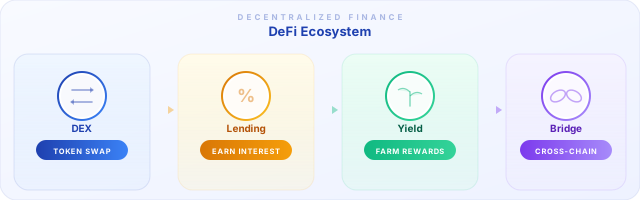
Uniswap is the largest decentralized exchange (DEX), allowing you to swap tokens directly from your wallet without an order book. It uses an AMM model where liquidity providers deposit token pairs into pools, and traders swap against these pools. Uniswap v3 and v4 introduced concentrated liquidity, letting LPs focus their capital in specific price ranges for higher efficiency.
Aave is the leading decentralized lending protocol. You can deposit tokens as collateral and borrow other tokens against them, or supply tokens to earn interest from borrowers. Aave supports flash loans — uncollateralized loans that must be borrowed and repaid within a single transaction — which are used for arbitrage and liquidation strategies.
Compound is another major lending protocol that pioneered the concept of algorithmic interest rates. Rates adjust automatically based on supply and demand for each asset. Lido is the largest liquid staking protocol, allowing you to stake ETH and receive stETH in return — a liquid token you can use across DeFi while still earning staking rewards.
Yield Farming Explained
Yield farming is the practice of moving your crypto between different DeFi protocols to maximize returns. At its simplest, you might deposit stablecoins into a lending protocol to earn interest. More advanced strategies involve providing liquidity to DEXs, stacking multiple protocols (for example, depositing LP tokens into a yield optimizer like Yearn), or farming governance token rewards.
Yields in DeFi can range from 2-5% APY on conservative stablecoin strategies to 50-100%+ on riskier new protocols. The general rule is that higher yields come with higher risk. Extremely high APYs (1000%+) are almost always unsustainable and may indicate a protocol that is subsidizing rewards with token emissions that will eventually cause price collapse.
Understanding Liquidity Pools and Impermanent Loss
A liquidity pool is a smart contract containing two (or more) tokens that traders can swap between. When you provide liquidity, you deposit both tokens in equal value. In return, you earn a share of trading fees proportional to your share of the pool.
Impermanent loss occurs when the price ratio between the two tokens in your pool changes after you deposit. The larger the price divergence, the greater the impermanent loss. For example, if you provide ETH/USDC liquidity and ETH doubles in price, you would have been better off simply holding ETH. The loss is "impermanent" because it reverses if prices return to the original ratio — but if you withdraw while prices are diverged, the loss becomes permanent.
DEX vs. CEX: When to Use Which
Centralized exchanges like Binance or Bybit Global are better for high-frequency trading, leveraged positions, and trading major token pairs with deep liquidity. They offer faster execution, lower slippage on large orders, and features like copy trading and grid bots.
DEXs are superior for trading new tokens not yet listed on CEXs, maintaining full custody of your assets, accessing DeFi-native yield strategies, and avoiding KYC requirements. Many experienced traders use both: CEXs for their main trading activity and DEXs for early-stage token access and DeFi strategies.
Risks in DeFi
Smart contract bugs are the most significant risk. Despite audits, DeFi protocols have suffered billions in losses from exploits. Rug pulls occur when a project's developers drain liquidity and disappear — this is more common with new, unaudited protocols. Oracle manipulation, governance attacks, and bridge exploits are other attack vectors.
Gas fees on Ethereum can make small transactions uneconomical. During peak congestion, a simple swap might cost $20-50 in gas. Layer 2 networks like Arbitrum and Base have reduced this to pennies, making DeFi accessible for smaller portfolios.
Getting Started with DeFi
To begin, you need a self-custody wallet like MetaMask (for Ethereum and EVMs), Phantom (for Solana), or a hardware wallet like Ledger. Fund your wallet by buying crypto on an exchange like Binance or Kraken and withdrawing to your wallet address. Start with a small amount on a well-established protocol like Aave or Uniswap, and practice basic operations before committing larger capital.