Why Exchange Security History Matters
Since the birth of cryptocurrency trading, exchange hacks have resulted in the loss of tens of billions of dollars. Understanding this history helps you identify red flags, evaluate exchanges, and protect your holdings.
Major Exchange Hacks: A Timeline
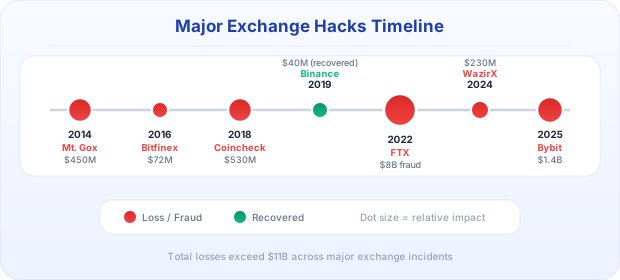
Mt. Gox — 2014 (850,000 BTC)
The world's largest exchange handling 70% of all BTC transactions. 850,000 BTC stolen over several years due to catastrophic key management — funds stored in hot wallets with no auditing. Became the catalyst for cold storage standards.
Bitfinex — 2016 (120,000 BTC)
Attackers exploited vulnerabilities in multi-signature wallet architecture. Bitfinex socialized losses across users (36% haircut) and issued IOUs. In 2022, $3.6B of stolen funds were recovered by US authorities.
Coincheck — 2018 ($530M in NEM)
$530M stored in a single hot wallet without multi-sig. Led directly to Japan's comprehensive crypto exchange regulations.
Binance — 2019 ($40M — Recovered via SAFU)
Binance lost 7,000 BTC through sophisticated social engineering. All losses covered by the SAFU insurance fund — no user lost money. Validated the concept of exchange insurance funds.
FTX — 2022 ($8B Fraud)
Not a hack but systematic fraud. $8B in customer funds misappropriated to Alameda Research. Triggered industry-wide adoption of Proof of Reserves. Binance, Bitget, Kraken, and Bybit Global all implemented PoR systems.
WazirX — 2024 ($230M)
Multi-sig wallet compromised through manipulated signing requests. Funds laundered through Tornado Cash within hours. Reinforced that multi-sig is not a silver bullet.
Bybit — 2025 ($1.4B, Lazarus Group)
The largest exchange hack in history. North Korea's Lazarus Group compromised Safe's signing interface via supply-chain attack. Bybit Global covered all losses and maintained withdrawals throughout. Exposed supply-chain dependencies.
How the Industry Improved
Cold storage: 90-95% of assets now kept offline. Proof of Reserves: Industry standard after FTX. Insurance funds: Binance SAFU, Bitget $300M fund. Regulation: MiCA, Japan FSA rules now require specific custody and capital standards.
How to Protect Yourself
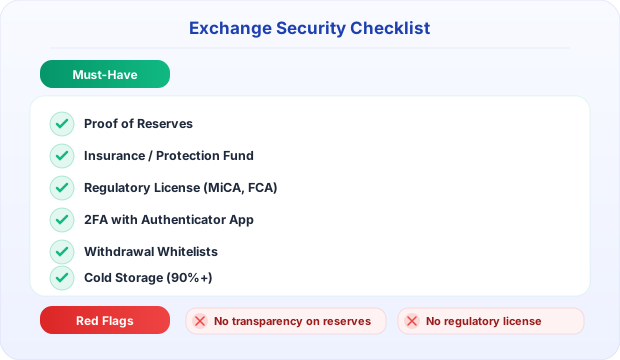
1. Choose exchanges with PoR, insurance funds, and regulatory licenses. 2. Enable 2FA with an authenticator app. 3. Use withdrawal whitelists. 4. Don't keep large amounts on exchanges — use hardware wallets. 5. Diversify across 2–3 exchanges like Binance, Kraken, and Bybit Global. 6. Learn to spot crypto scams.