What Is Copy Trading?
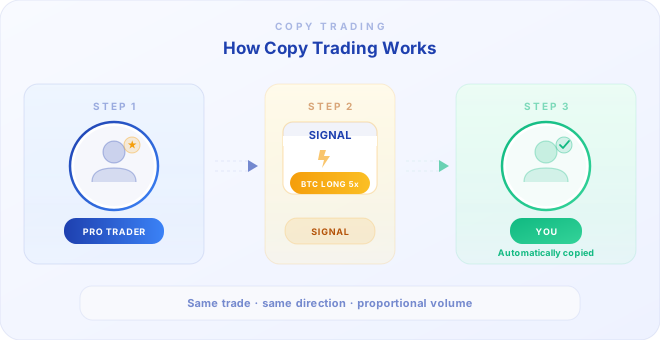
Copy trading allows you to automatically replicate the trades of experienced traders in real time. When a lead trader opens a position, the same trade is executed in your account proportionally to your allocated capital. You do not need to analyze charts, monitor markets, or place orders yourself — the system handles everything after you select a trader to follow.
This approach has become one of the fastest-growing features in crypto, particularly for newer traders who want market exposure without the steep learning curve of technical analysis. If you are new to crypto, our beginner's guide covers the fundamentals. Copy trading also appeals to experienced traders who want passive income streams alongside their active strategies.
How Copy Trading Works
The mechanics are straightforward. You browse a marketplace of lead traders, review their performance statistics, risk metrics, and trading history, then allocate a portion of your capital to follow them. The platform automatically mirrors their trades in your account, adjusting position sizes based on your allocated amount.
Most platforms let you set parameters like maximum position size, stop-loss limits, and the total capital allocated to a single trader. You can follow multiple traders simultaneously to diversify your exposure. You retain full control and can stop copying at any time, close individual positions, or withdraw your funds.
Copy Trading Platforms Compared
Bitgetis the undisputed leader in crypto copy trading with over 800,000 lead traders and the most mature feature set in the industry. Their copy trading marketplace offers detailed statistics including ROI, maximum drawdown, win rate, Sharpe ratio, and follower count. Bitget supports both spot and futures copy trading and offers a profit-sharing model where lead traders earn 10% of followers' profits.
Bybit Global has invested heavily in its copy trading ecosystem, offering a clean interface and strong filtering tools. Their platform highlights traders by strategy type and risk level, making it easier for beginners to find a match. BingX is another strong contender with a social trading feed that adds a community dimension — you can see trader commentary and analysis alongside their positions.
WEEX and BloFin both offer copy trading features focused on futures markets, catering to more aggressive strategies. MEXC provides basic copy trading functionality, though its marketplace is smaller than the leaders. Binance entered the copy trading space later than some competitors but brings its massive liquidity advantage, ensuring minimal slippage when trades are replicated.
What to Look for in a Lead Trader
The most important metric is not raw ROI — it is risk-adjusted return. A trader who earned 500% but had a maximum drawdown of 80% is far riskier than one who earned 100% with a 15% drawdown. Look for traders with at least 90 days of track record, consistent returns rather than a single lucky trade, and a maximum drawdown you can stomach.
Check the number of followers and their average profit. If a trader has thousands of followers but most are losing money, that is a red flag — it may indicate that slippage or timing differences are eating into returns. Prefer traders who manage reasonable capital relative to their follower base.
Win rate alone is misleading. A trader with a 90% win rate who occasionally takes a catastrophic loss can wipe out months of gains in a single position. Look at the profit factor (gross profits divided by gross losses) and the average risk-reward ratio per trade instead.
Fee Structures in Copy Trading
Copy trading fees typically have two components. First, you pay standard trading fees on every replicated trade — the same maker and taker fees that apply to manual trading. Second, most platforms charge a profit-sharing fee where the lead trader receives a percentage of your profits, usually between 8% and 15%.
On Bitget, lead traders earn 10% of follower profits as the standard rate. Some platforms let lead traders set their own profit-sharing percentage up to a cap. There are no fees if your copy trading position results in a loss — you only pay when you profit.
Risks and Limitations
Copy trading is not a guaranteed path to profit. Past performance does not predict future results, and even the best traders go through drawdown periods. Slippage is a real concern: if a lead trader executes a trade and thousands of followers simultaneously copy it, the entry price for followers may be worse than the lead's price, especially in illiquid markets.
You also face the risk of over-concentration. Following a single trader who goes on a losing streak can be devastating. Diversify across multiple traders with different strategies — for example, one trend-follower, one mean-reversion trader, and one conservative scalper.
Tips for Beginners
Start with a small allocation — no more than 5-10% of your total portfolio. Use the demo or paper trading copy features if available to test before committing real capital. Set hard stop-losses at the account level so that no single trader can draw down your copy portfolio beyond your tolerance. Review your copy trading performance weekly and do not hesitate to unfollow a trader who deviates from the strategy that attracted you in the first place.